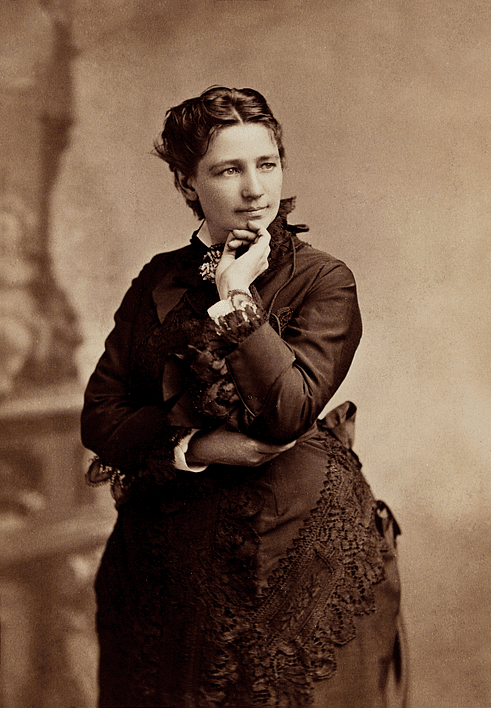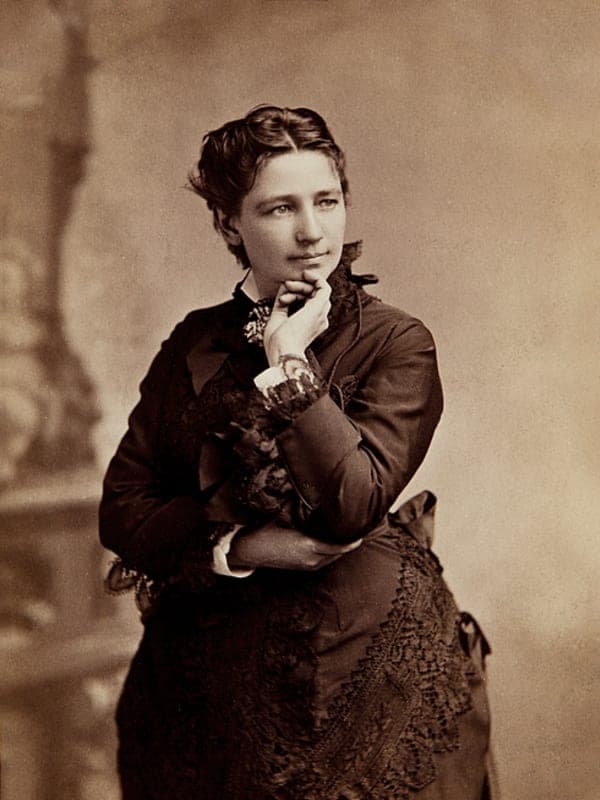
On a February morning in 1870, two women in matching outfits arrived at the corner of Wall Street and Broad Street in a horse-drawn carriage to meet a crowd of thousands. Victoria Woodhull and her sister Tennessee Claflin were opening Woodhull, Claflin & Company — the first brokerage firm on Wall Street ever owned by women1. Bankers, brokers, journalists, and errand boys had turned out to see the debut. The sisters hung a sign inside the door: "Gentlemen will state their business and then retire at once." An estimated four thousand visitors came on that first day anyway, most of them men2.
Early Life
Victoria Claflin had grown up with very little formal schooling — three years of inconsistent attendance at a Methodist Church school in Homer, Ohio, before her family left town under suspicion that her father had burned down his own mill for the insurance money1. She spent her early years in the family's traveling medicine show, telling fortunes and selling homemade remedies.1 She was fifteen when she married Dr. Canning Woodhull, whom she later described as a habitual drunkard. She worked as a seamstress, a stage actress, and a spiritual medium to keep the household running.
Career
After her divorce, Woodhull moved to New York with her sister Tennessee and married a second husband, Civil War veteran Colonel James Blood. The two sisters built a practice as healers and clairvoyants — Victoria working primarily as a spiritualist and clairvoyant, Tennessee as a "magnetic healer" — and it was their father, Buck Claflin, who engineered the introduction to Cornelius Vanderbilt. He approached the Commodore barely a month after the death of Vanderbilt's wife Sophia in 1868, pitching Victoria as someone who could contact the dead and Tennessee as a physical healer. Vanderbilt, then 74, took up both offerings. In return he provided financial advice and direct backing that gave the sisters their foothold on Wall Street. The $700,000 the sisters later claimed to have accumulated — including gains during the 1869 gold panic — has been widely questioned by historians; Vanderbilt's role appears to have been more that of a silent financier than simply a source of trading tips, and their actual starting capital was likely a good deal smaller. Whatever the precise figure, it was enough to open their Wall Street firm in 1870.
The firm itself was built for a client base male Wall Street had been ignoring: women who wanted to invest their money but found that professional brokers did not take them seriously. The press — half mocking, half transfixed — dubbed the sisters the "Bewitching Brokers" and, later, the "Queens of Finance." Within three months of opening, the business was profitable enough to fund the launch of Woodhull & Claflin's Weekly on May 14, 1870 — among the first newspapers in the country to be published by women. Most of the copy was written by Woodhull, Claflin, Colonel James Blood, and the radical philosopher Stephen Pearl Andrews, and the paper ranged across women's suffrage, free love, spiritualism, vegetarianism, and socialism. It opened with four pages of advertising.
That same year Woodhull had announced her presidential candidacy in an 1870 letter to the New York Herald, drawing the sharpest possible line between argument and action: "While others argued the equality of woman with man, I proved it by successfully engaging in business; while others sought to show that there was no valid reason why woman should be treated socially and politically as a being inferior to man, I boldly entered the arena of politics and business and exercised the rights I already possessed."
The cracks in the brokerage appeared as her political ambitions crowded out the trading floor: by 1871, clients were growing disgruntled over speculation in gold, and as the presidential campaign intensified over the next two years, the firm slowly shed business. By the summer of 1873 it existed in name only. The Weekly outlasted it, reaching a national circulation of 20,000 at its peak before finally ceasing publication on June 10, 1876.
In January 1871, a year after opening the brokerage, Woodhull traveled to Washington to press the case for women's suffrage before Congress. Suffrage leaders, including Susan B. Anthony and Isabella Beecher Hooker, had postponed the opening of the National Woman Suffrage Association's third annual convention in order to attend the committee hearing.3 On January 11, 1871, flanked by Anthony and Hooker, Woodhull became the first woman to address a House committee.4 Her argument was not that women deserved the vote — it was that they already had it. The Fourteenth and Fifteenth Amendments, she told the Judiciary Committee, granted suffrage to all citizens without specifying sex. Frank Leslie's Illustrated Newspaper printed a full-page engraving of the scene.3 The committee rejected her petition, but two of its members filed a minority opinion in her favor5, and Woodhull arrived back in New York as a recognized leader of the suffrage movement.
On May 10, 1872, the newly formed Equal Rights Party nominated her at Apollo Hall in New York City — the first woman nominated for the presidency6. The party also nominated Frederick Douglass for vice president, though he never acknowledged or accepted6. Woodhull's newspaper, Woodhull & Claflin's Weekly — which had already published the first English-language edition of Karl Marx's Communist Manifesto in December 18718 — became her campaign organ, circulating to a national readership of 20,0007. Then, one week before Election Day, the November 2 issue hit the streets carrying a detailed account of an adulterous affair between the Reverend Henry Ward Beecher, America's most prominent clergyman, and Elizabeth Tilton9, the wife of Beecher's friend Theodore Tilton. Woodhull's charge was not about the affair itself, which she supported on free-love grounds; it was about the hypocrisy of a man who preached marital fidelity while practicing otherwise. The response was immediate. U.S. Marshals arrested Woodhull, her sister, and her husband under the Comstock Act for sending obscene material through the mail.3 She spent Election Day in jail.10 The obscenity case eventually collapsed in court, but the legal battles cost nearly $500,000 in bail and fines before they were done3. Beecher himself stood trial in 1875 for adultery; the case ended in a hung jury.3 Woodhull's name had not even appeared on the ballot — she was constitutionally too young to be inaugurated6.
Legacy
Nearing bankruptcy, Woodhull moved to England in 1877 and remarried in 1883 — this time to John Biddulph Martin, an aristocratic banker she had met at one of her lectures.11 In England she published The Humanitarian, a journal that ran from 1892 to 1901.1 The journal promoted eugenics alongside women's rights, a position that reflected mainstream progressive thought of the late nineteenth century but that caused harm to those targeted as inferior1, and it remains the most contested chapter of her intellectual record. She died in Worcestershire on June 9, 1927, at eighty-eight.12 In 2001, she was posthumously inducted into the National Women's Hall of Fame.13