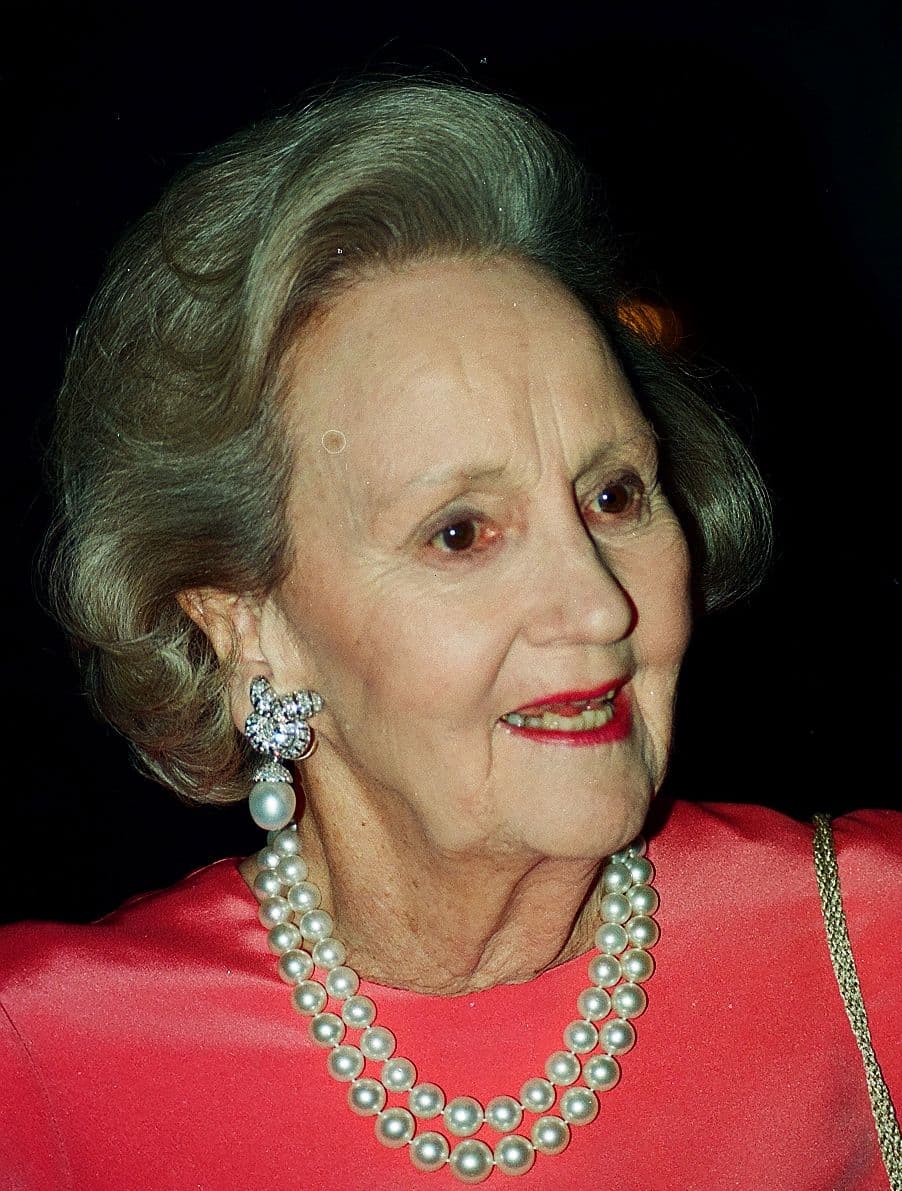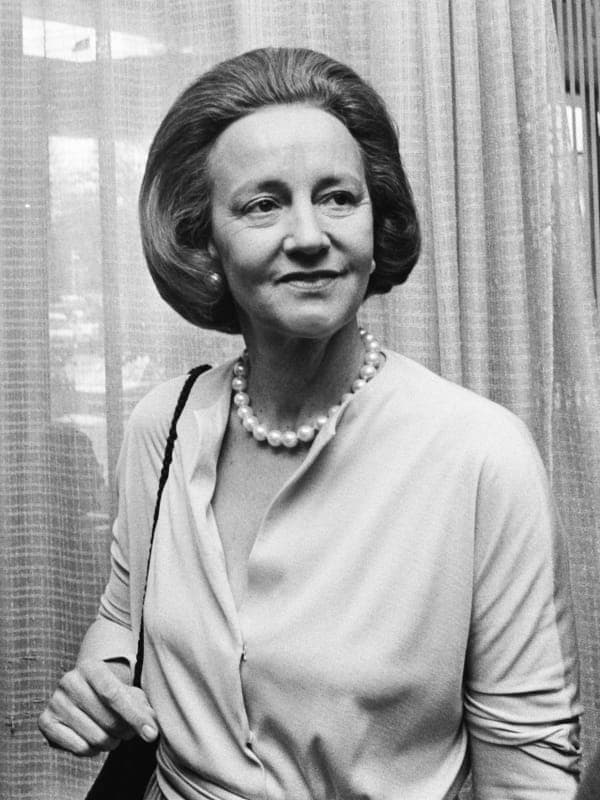
On the evening of June 17, 1971, Katharine Graham was in the middle of delivering a toast at a farewell party in her Georgetown home when she was called to the telephone. On the other end was a decision that could end her newspaper. The Washington Post had obtained a partial copy of the Pentagon Papers — the classified 7,000-page Defense Department history of American involvement in Vietnam — two days after she had taken the company public, putting a $35 million stock offering and the Post's television broadcast licenses into legal jeopardy.1 Her lawyers said don't publish. Her editors said failing to publish would be gutless. Graham took a breath and said: "Go ahead, go ahead, go ahead. Let's go. Let's publish.1"
Early Life
After graduating from the University of Chicago in 1938, Graham went west to work as a waterfront reporter for the San Francisco News, where she helped cover a major wharf workers' strike.2 The job lasted less than a year before she returned to Washington to join the Post's editorial staff, handling letters to the editor and writing light editorials at $25 a week2. Her father, Eugene Meyer, had bought the paper at a bankruptcy auction in 1933 for $825,0003 — she had been sixteen and no one had thought to tell her. When Meyer needed a successor in 1946, he handed the publisher's title to her husband, Philip Graham, a Harvard Law School graduate who had clerked for two Supreme Court justices. Katharine wrote later that it never crossed her mind to feel slighted: "In fact, it never crossed my mind that he might have viewed me as someone to take on an important job at the paper.4" She stepped away from the paper entirely, raising four children in Georgetown while Philip expanded the company with acquisitions of Newsweek and the rival Times-Herald. By the early 1960s the Post's daily circulation had more than doubled to 400,000.5 Then, on August 3, 1963, Philip Graham died by suicide at the couple's Virginia estate.
Career
Graham assumed the presidency of the Washington Post Company in September 1963 at forty-six, surrounded almost entirely by male editors and executives, and described herself at the time as planning to support the strong men around her until one of her children could take over. Her first concrete move toward building a paper rather than merely inheriting one came in 1968, when she named Ben Bradlee executive editor4 — a hire that set the Post on its path toward aggressive investigative reporting. The Pentagon Papers decision three years later, made over the phone from her own party while her lawyers warned of criminal liability and the loss of broadcast licenses, established what kind of publisher she intended to be. The Supreme Court ruled six to three in the Post's favor on June 30, 19716, vindicating her call and vaulting the paper into the front rank of American journalism. The Watergate investigation followed, with Bob Woodward and Carl Bernstein pursuing a story the Nixon administration worked hard to kill. Attorney General John Mitchell threatened that Graham would "get her tit caught in a big fat wringer" if it was published.7 Nixon warned privately that the Post's television stations would face license challenges.6 Graham kept the reporting going. Nixon resigned in August 1974.
The business test she considered the hardest came on October 1, 1975, when the pressmen's union struck, vandalized the pressroom, set fire to a press, and beat the night foreman badly enough to require a dozen stitches8. In her memoir, Graham devoted nearly seventy pages to the strike and only forty-five to Watergate.8 She flew press pages out by helicopter in the early weeks5, brought in replacement workers in December, and refused to settle even when her friend Edward Bennett Williams urged her to back down. When AFL-CIO president George Meany privately asked what she would have done if the pressmen had accepted her final offer, she answered: "Slit my throat."8 The strike ended after 139 days.5 Before it, the Post had never been highly profitable; afterward, profits soared — especially after the rival Washington Star folded in 1981.8 The pressmen's union, which had effectively run the production floor, was replaced by nonunion crews half its size.5 Graham called it painful and said she never wanted it; the union's leaders called it union-busting. It was both a financial transformation and a contested one, and she knew it.
Running a company that covered Washington was not the same as being inside it, and Graham was both. For decades her home at 2920 R Street served as a working salon where every president from Kennedy onward except Nixon came to dinner, and where the guest list on any given evening could include heads of state, cabinet secretaries, CIA directors, and the journalists who covered them. Movie lobbyist Jack Valenti put it plainly: there were two invitations in Washington you did not turn down — the White House and Katharine Graham's. That proximity was double-edged. It was part of what made the Post indispensable in the capital's information economy, and it was the same entanglement Graham acknowledged in her memoir when she noted that her husband's intimacy with politicians — including a hand in placing Lyndon Johnson on the 1960 ticket — would be considered unacceptable in journalism today. She inherited the network, kept it, and used it; the question of where social influence ended and editorial independence began was one she navigated, not one she resolved.
Legacy
From 1963 to 1991, the Washington Post Company's revenue grew from $84 million to $1.4 billion.5 In 1972, when Graham became CEO of the company, she was the first woman to hold that title at a Fortune 500 firm.9 In 1974 she became the first woman elected to the board of directors of the Associated Press.4 In 1997, at eighty, she published her memoir Personal History, which won the Pulitzer Prize for biography the following year4. She had written it, a Smithsonian historian later suggested, partly to set the record straight: she had been left out of the 1976 film All the President's Men almost entirely, with Robert Redford explaining that no one understood the role of a publisher and it was too extraneous to include10. Graham wrote that she was surprised to find her feelings hurt. In 2002, President George W. Bush awarded her the Presidential Medal of Freedom posthumously.4 She had died the year before, on July 17, 2001, after a fall in Sun Valley, Idaho — on her way to a bridge game.11