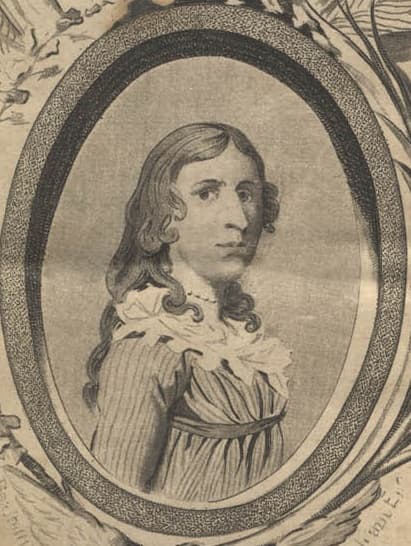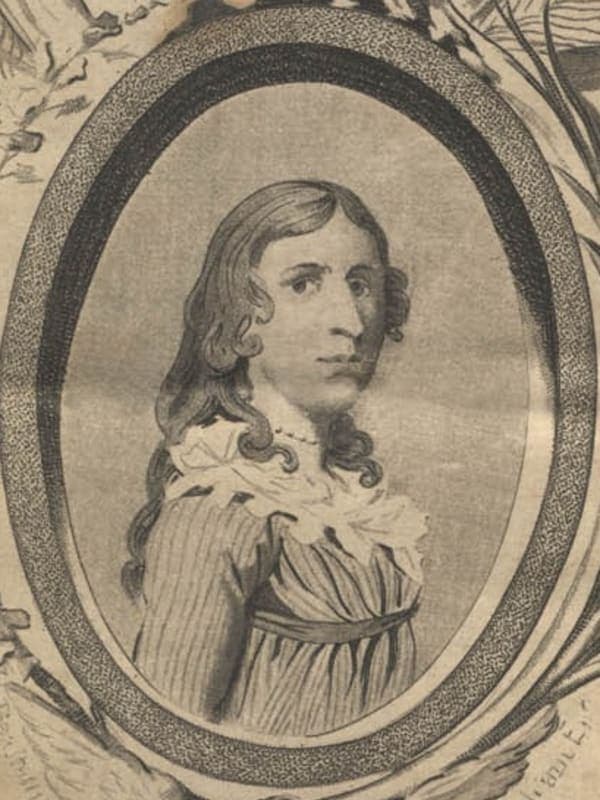
In March 1802, an audience at Boston's Federal Street Theater watched a forty-one-year-old farmwife step to the lectern and describe, in precise detail, how she had bound her chest with cloth, put on a man's name, and marched with an elite light infantry company through the Hudson Valley. Then she left the stage, returned in her old army uniform, and moved through a twenty-seven-step manual-of-arms drill without missing a beat. The audience, her biographer recorded, reacted with "universal acclimations of joy."1 Deborah Sampson had fought for seventeen months as Private Robert Shurtleff of the Fourth Massachusetts Regiment2, taken a musket ball in the thigh and a sword cut to the forehead, extracted one piece of shot herself with a penknife2, and left the other lodged in her leg for the rest of her life3. The lecture tour was her second campaign — this one fought in public, for the pension the army still owed her.
Early Life
At age ten, Sampson was bound out as an indentured servant to Deacon Benjamin Thomas, a farmer in Middleborough, Massachusetts, where she worked until she turned eighteen.4 The Thomas family did not send her to school, but she learned alongside the Thomas sons, studying their schoolbooks in the evenings after farm work. When her indenture ended in 1778, she was self-educated enough to work as a schoolteacher during summer sessions in 1779 and 1780, and as a weaver through the winters — skilled enough, one account notes, that she worked for the Sproat Tavern and several prominent local families2. By her early twenties, she was steadily employed and chronically underpaid, with no dowry and no marriage prospects. Towns struggling to fill their enlistment quotas were offering bounties to volunteers.
Career
In early 1782, Sampson made her first enlistment attempt in Middleborough under the name Timothy Thayer wearing clothes borrowed from a family she was working for, but was recognized by a neighbor when she signed the papers 2 That summer, she sewed a suit of men's clothes from cloth she had woven herself and left Middleborough1. On May 23, 1782, she walked into a recruitment station and enlisted as Robert Shurtleff.5 This time, the disguise held. She was assigned to the Light Infantry Company of the Fourth Massachusetts Regiment, an elite unit that accepted only soldiers standing at least five feet five inches tall who could sustain rapid tactical marching6. She stood roughly five feet seven.7
She was wounded in Westchester County that summer — a musket ball in the thigh and a sword cut to the head.8 When soldiers carried her to a field hospital, a doctor treated the head wound; she slipped out before he could reach her leg, removed one ball herself with a penknife and sewing needle, and left the other where it was2. She served for another year before being sent to Philadelphia with General Paterson's contingent in the summer of 1783. There, she fell unconscious with a fever. Dr. Barnabas Binney, treating her in the hospital, discovered her sex and reported it by letter to her commanding general.6 She received an honorable discharge at West Point on October 25, 1783, signed by Major General Henry Knox.9
The discharge settled nothing financially. In January 1792, Sampson petitioned the Massachusetts State Legislature for the back pay the army had withheld because she was a woman. Governor John Hancock signed the award: thirty-four pounds plus interest back to her 1783 discharge.2 It was not enough. Her husband, Benjamin Gannett, a struggling farmer in Sharon, earned little, and the wound in her leg continued to cost her in medical bills. Five years earlier, Herman Mann had published The Female Review (1797), a biography that circulated widely enough to give her a ready audience. Beginning in March 1802, she traveled alone through Massachusetts, Rhode Island, and New York — Boston, Providence, Worcester, Albany, Schenectady, New York City6 — delivering her account and finishing each show in uniform performing the manual of arms. It was the first national lecture tour by a woman in American history.4 The tour did not solve the money problem either. In 1804, Paul Revere visited her Sharon farm, saw her circumstances for himself, and wrote to U.S. Representative William Eustis.10 His letter told Eustis she was "much more deserving than hundreds to whom Congress have been generous."10 On March 11, 1805, Congress placed her on the Massachusetts Invalid Pension Roll at four dollars a month — the first military pension awarded to an American woman.2
Legacy
Sampson died on April 29, 1827, in Sharon, Massachusetts.2 The Gannetts were too poor to pay for a headstone; her grave in Rock Ridge Cemetery went unmarked for more than twenty years1. When a stone was finally placed, it identified her as "Deborah, Wife of Benjamin Gannett." Four years after her death, Benjamin petitioned Congress for survivor benefits as the spouse of a soldier. In 1837, the committee reviewing his petition declared that the history of the Revolution "furnished no other similar example of female heroism, fidelity and courage."4 He was awarded the payment but died before receiving it. In December 2020, Congress passed the Deborah Sampson Act, signed into law as part of the Veterans Health Care and Benefits Improvement Act, establishing an Office of Women's Health within the Department of Veterans Affairs.2 The pension she fought for from 1790 until her death — four dollars a month, secured only through Paul Revere's intervention — eventually lent its holder's name to a federal law covering the health care of more than two million women veterans.