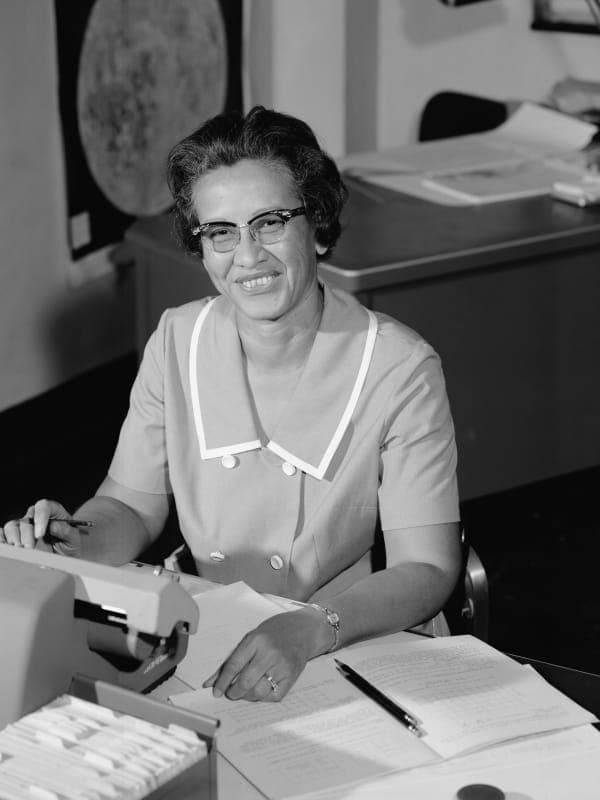
In February 1962, with John Glenn's Friendship 7 capsule sitting on the launch pad at Cape Canaveral and IBM 7090 computers at Goddard Space Flight Center holding the orbital trajectory, Glenn issued one condition before he would fly. As part of the preflight checklist, he asked engineers to get the girl — meaning Katherine Johnson — to run the same numbers through the same equations, by hand, on her desktop mechanical calculating machine.1 "If she says they're good," Johnson remembers Glenn saying, "then I'm ready to go."1 It took her a day and a half. The numbers matched.2 Glenn flew, orbited Earth three times, and splashed down safely in the Atlantic.3
Early Life
The local segregated schools in White Sulphur Springs, West Virginia, offered Black children no instruction past the eighth grade.4 So Katherine Coleman's father relocated the family 120 miles to Institute5, where she could attend the high school on the campus of West Virginia State College. She finished secondary school at 13 and enrolled in the college itself the following year.4 At West Virginia State, a professor named William W. Schieffelin Claytor — the third African American ever to earn a Ph.D. in mathematics — told her she would make a good research mathematician and created a class in analytic geometry of space specifically for her.6 Johnson graduated summa cum laude at 18 with degrees in mathematics and French.4 In 1939, she was one of three Black students hand-picked to integrate West Virginia University's graduate program — the first Black woman to do so7 — though she left after one year to start a family. She spent the next 13 years raising three daughters, then return to teaching when her husband fell ill in 1952. That same year, a relative mentioned at a family gathering that NACA's Langley laboratory was hiring Black women as "computers."1
Career
Johnson started at Langley in the summer of 1953, assigned initially to the all-Black all-female West Area Computing section run by Dorothy Vaughan.1 Two weeks in, Vaughan sent her to fill an opening in the Flight Research Division — an all-male all-White group that worked on actual aircraft rather than wind-tunnel simulations. The assignment was meant to be temporary.1 Johnson's knowledge of analytic geometry made it permanent. She analyzed data from flight tests and worked on the investigation of a plane crash caused by wake turbulence. When the men in her division attended editorial briefings from which women were excluded, Johnson kept asking questions about what was discussed until, by 1958, the division let her attend the meetings herself.8 That same year she contributed to Notes on Space Technology, the agency's first comprehensive reference document on spaceflight9 — a transition accelerated by Sputnik, which had launched in 1957. In 1960, she co-authored a report laying out the equations for determining landing position for orbital spaceflight, becoming one of the first women in the Flight Research Division to receive credit as a named author on a research report.10
By 1961 she had calculated the trajectory for Alan Shepard's Freedom 7 mission — the first American in space — entirely by hand, with recovery crews relying on her figures to locate his capsule in the North Atlantic.10 The Glenn verification the following year established her professional reputation across the agency. When asked later to name her greatest contribution, Johnson did not point to Glenn. She pointed to the calculations that synchronized the Apollo Lunar Module with the lunar-orbiting Command and Service Module — the problem of having one spacecraft rendezvous with another while both are in motion around the moon.1 Any error in those figures would have stranded Armstrong and Aldrin on the lunar surface or in lunar orbit. She also provided the backup procedures that helped bring Apollo 13 home after its craft malfunctioned.11 She authored or co-authored 26 research reports over her career and retired from Langley in 1986, after 33 years.1
Legacy
In 2015, President Barack Obama awarded Johnson the Presidential Medal of Freedom at age 97.1 In 2019, Congress awarded her the Congressional Gold Medal — the two highest civilian honors available to an American.12 In September 2017, NASA dedicated the Katherine G. Johnson Computational Research Facility at Langley Research Center5, and in 2021, Northrop Grumman named one of its Cygnus resupply spacecraft — a vehicle that services the International Space Station — the S.S. Katherine Johnson.4 In 2023, her personal collection of notebooks, photographs, correspondence, and awards was donated to the West Virginia and Regional History Center at West Virginia University.4 She died on February 24, 2020, at her home in Newport News, Virginia. She was 101.13