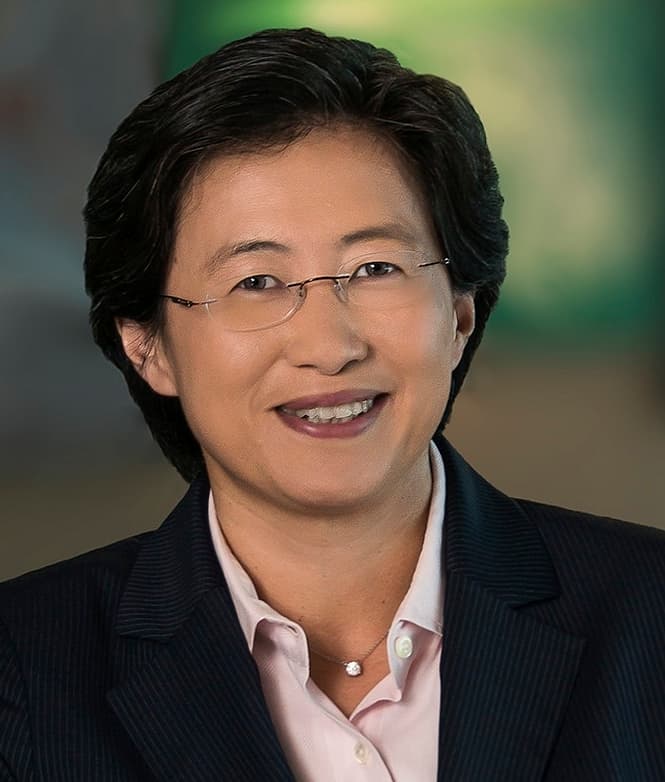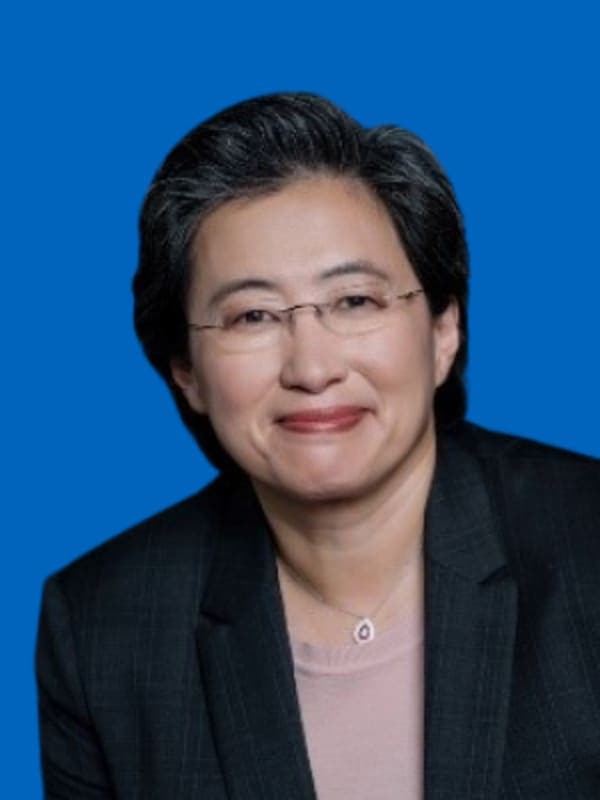
In October 2014, Lisa Su was named CEO of the struggling chip maker AMD. The stock was trading around two dollars1 and market capitalization sat at roughly three billion.2 AMD had lost most of its server business, its PC chip line was collapsing, and it had fallen behind on nearly every technical front. Su had spent her career building chips from the silicon up. She did a PhD at MIT on transistor physics, then spent thirteen years at IBM where she innovated on chips and then worked on strategy alongside CEO Lou Gerstner. She told CNN Business what she felt taking the job: "When you grow up as a tech person — and I spent my career in semiconductors — there aren't that many large US semiconductor companies. So I was really excited to become CEO."3
Early Life
Su arrived at MIT in the fall of 1986, intending to study electrical engineering or computer science, and settled on electrical engineering because, by her own account, it seemed like the most difficult major.4 During her freshman year, she was already in a lab, manufacturing test silicon wafers for graduate students through MIT's Undergraduate Research Opportunities Program.4 By the time she finished her doctorate in 1994 — a dissertation on extreme-submicrometer silicon-on-insulator transistors4 — she had spent her entire undergraduate and graduate education in semiconductor labs, adjusting real devices rather than theorizing about them.
Career
At IBM, starting in 1995, she ran straight into a problem the industry had been trying to solve for years: how to replace the aluminum wiring inside chips with copper, which conducted electricity better, without letting copper contaminate the silicon around it. Su played a critical role in cracking the process. IBM launched the first copper-interconnect production chips in 1998; they ran up to twenty percent faster than their aluminum predecessors and set a new industry standard.4 From there, she was assigned as technical assistant to CEO Lou Gerstner in 20004, a year spent inside corporate strategy rather than a device lab. Su then founded IBM's Emerging Products division, where her team contributed to the Cell microprocessor that powered the Sony PlayStation 34. She left IBM in 2007 for Freescale Semiconductor as chief technology officer4, taking profit-and-loss responsibility for the first time.
When Su joined AMD in January 2012 as senior vice president and general manager for global business units, roughly ten percent of the company's revenue came from products outside the PC market5. She moved that figure to about forty percent within three years5 by landing AMD chips inside the Microsoft Xbox One and Sony PlayStation 45, a semi-custom business that would later keep the company solvent while she rebuilt everything else. She was named president and CEO on October 8, 2014, becoming the first woman to lead a major semiconductor company.6
What she inherited required more than operational repair. AMD's existing CPU architecture, Bulldozer, was losing badly to Intel on performance per watt. A replacement architecture called Zen had already been started, but funding it through AMD's worst financial years, 2015 and 2016, when the company was drawing down cash reserves and the board was not uniformly convinced7, was Su's call to make. She kept the budget. In March 2017, Zen launched as the Ryzen processor line and benchmarked within a few percent of Intel's best chips at significantly lower prices.7 AMD was the best-performing stock in the S&P 500 in 2018.6 The console and data-center revenue that followed gave Su the resources for a second, larger move.
In October 2020, she announced AMD's agreement to acquire Xilinx8, the field-programmable gate array specialist, in an all-stock deal. By the time the transaction closed on February 14, 2022, AMD's own soaring stock had pushed the deal's value to forty-nine billion dollars, making it the largest semiconductor acquisition in history at the time.9 The combination added Xilinx's FPGA and adaptive computing products to AMD's CPU and GPU portfolio, positioning the company across data centers, edge computing, and AI accelerators — the markets that would define the decade. That same year, AMD overtook Intel in market capitalization.4
Legacy
By 2024, AMD reported record annual revenue of $25.8 billion10, with data center segment revenue — driven by EPYC processors and Instinct AI accelerators — nearly doubling year over year to $12.6 billion10. AMD's market capitalization had grown from roughly three billion dollars when Su became CEO to more than seven hundred billion.4 Su was named Time magazine's CEO of the Year in 2014 and again in 2024 — the only woman to ever receive this award.4 In 2019, she was the highest-paid CEO across the entire S&P 500. In 2021, she became the first woman to receive the IEEE Robert N. Noyce Medal, the institute's highest semiconductor honor.1 In 2022, MIT named its new nanotechnology research building — Building 12 — after her.4