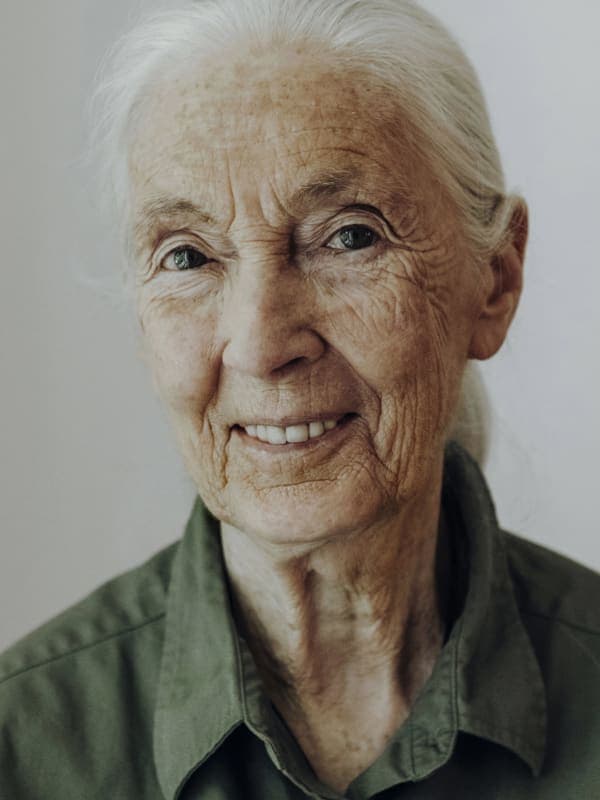
In October 1960, on a rocky outcrop above Gombe Stream Game Reserve in what is now Tanzania, a 26-year-old Jane Goodall raised her binoculars toward a chimpanzee she had named David Greybeard.1 She watched as he pushed a stem of grass into a termite mound, withdrew it coated with insects, and ate them — then stripped the leaves from a small twig to make the tool more effective.1 When she telegraphed the finding to Louis Leakey in Nairobi, he cabled back: 'NOW WE MUST REDEFINE TOOL STOP REDEFINE MAN STOP OR ACCEPT CHIMPANZEES AS HUMAN.'2 The behavior had been there all along, in a forest no scientist had sat in long enough to see it.
Early Life
Goodall grew up in Bournemouth, England, unable to afford university after finishing school. She attended secretarial school in South Kensington instead, learning typing, shorthand, and bookkeeping3 — the skill set that got her a job. In 1957, she saved enough money waitressing to buy a one-way passage to Kenya4, where a friend had a farm in the White Highlands. There she telephoned the paleoanthropologist Louis Leakey, intending only to talk about animals. Leakey hired her as a secretary at the Nairobi natural history museum, brought her to Olduvai Gorge, and watched her work. He believed that someone without a formal academic training would observe chimpanzees without the bias of established theory — and that a woman would be more patient and insightful in the field than a male observer.5 By 1960, he had secured a grant from the Wilkie Brothers Foundation3 and arranged an expedition to Gombe. The British colonial authorities refused to let Goodall go alone into the forest, so her mother, Vanne, volunteered to chaperone. On July 14, 1960, the two women arrived by boat on the eastern shore of Lake Tanganyika.3
Career
The first weeks at Gombe nearly ended the project. Goodall developed what was likely malaria, and the chimpanzees fled whenever she approached. Leakey had secured only six months of funding. In her own account, the months of fruitless searching through heat and fever were 'depressing, wet and chimpless.' That ended in October 1960, when David Greybeard held still long enough for Goodall to watch him fish for termites — and then modify a twig to do it better.6 Tool use and toolmaking had been considered the exclusive domain of humans. Within months, she had also documented chimpanzees hunting colobus monkeys and sharing meat, behaviors equally foreign to what science had assumed about the species.7 Leakey arranged for Goodall to begin a Ph.D. in ethology at Cambridge University in 1962 — she was the eighth person admitted to pursue a doctorate there without a prior bachelor's degree.8 At Cambridge, senior scientists objected to her giving the chimpanzees names rather than numbers, and to her ascribing emotions and personalities to individual animals. She held her position. 'How naïve I was,' she later wrote in a 1998 essay for Science. 'As I had not had an undergraduate science education, I did not realize that animals were not supposed to have personalities, or to think, or to feel emotions or pain.'9 She received her Ph.D. in February 1966.3 The findings she had written about for National Geographic since 1963 had already made her a public figure; when Miss Goodall and the Wild Chimpanzees aired on CBS on December 22, 1965, an estimated 25 million North American viewers watched.10
In 1986, Goodall helped organize a conference called 'Understanding Chimpanzees,' hosted by the Chicago Academy of Sciences.11 Researchers from field sites across Africa compared notes, and the pattern was uniform: forests disappearing, chimpanzee populations collapsing, animals being taken for medical laboratories.12 'I went to the conference as a scientist,' she said afterward. 'I left as an activist.'12 She did not return to Gombe as a resident researcher. Instead, she began traveling — eventually spending approximately 300 days a year on the road13 — to lobby governments and speak to audiences from heads of state to schoolchildren. In 1991, twelve high school students gathered at her home in Dar es Salaam and described feeling powerless against the problems around them.14 From that meeting, Goodall launched Roots and Shoots, the youth conservation program that grew to operate in more than 140 countries, with more than 8,000 local groups.15
Legacy
Goodall died on October 1, 2025, in Los Angeles, while on a U.S. speaking tour.16 She was 91.16 The morning of her death, she had been scheduled to appear at EF Academy in Pasadena for the planting of 5,000 trees around wildfire burn zones in the Los Angeles area.17 When organizers learned she had died as the event was about to begin, the first tree was planted in her name after a moment of silence.18 The Gombe Stream Research Center, founded in 1965, continues as the longest-running field study of wild chimpanzees in the world.19