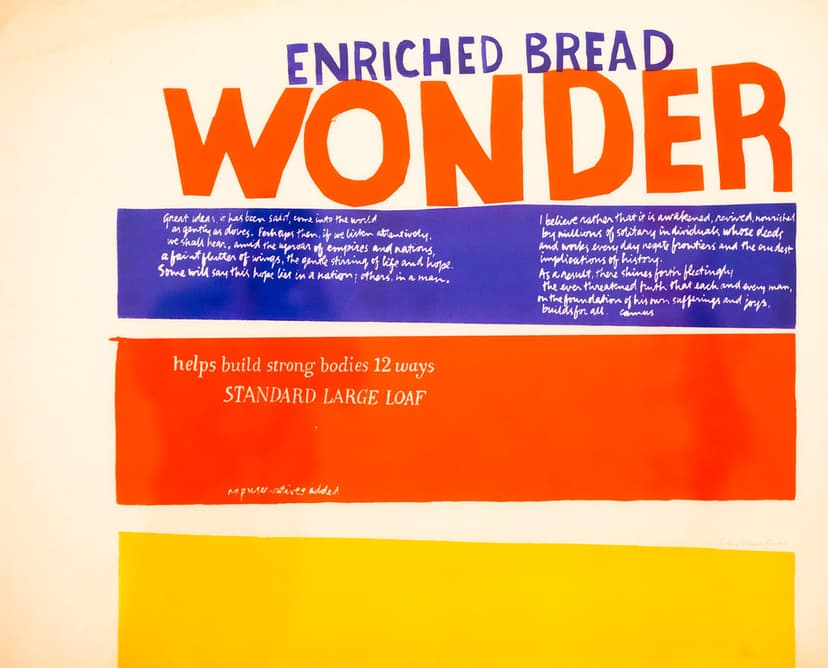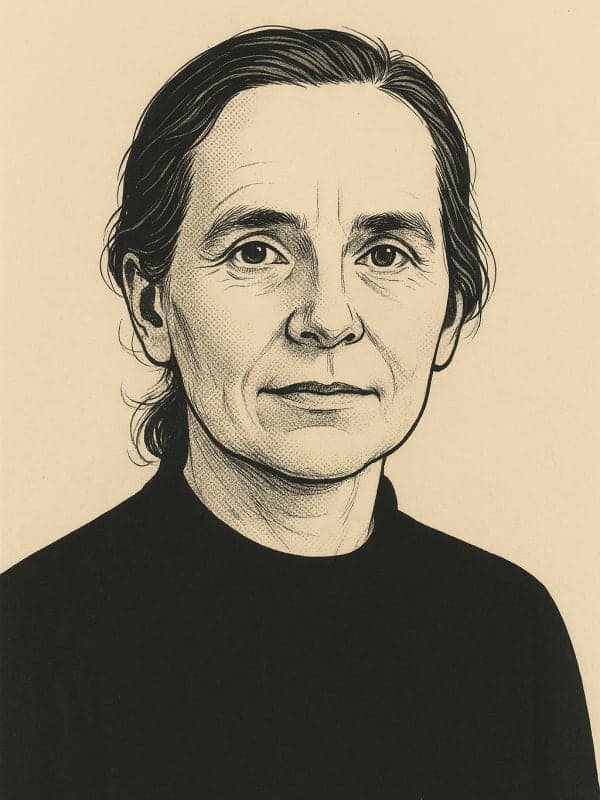
In the summer of 1962, Corita Kent — Sister Mary Corita, still in her habit — walked into the Ferus Gallery on La Cienega Boulevard and stood in front of Andy Warhol's Campbell's soup cans. She later said the show taught her to see.1 She drove back to Immaculate Heart College in the Los Feliz hills and began photographing supermarket signage, tearing apart advertising spreads, and feeding the wreckage through a silkscreen. Within a year, her prints had stopped looking like illuminated manuscripts and started looking like billboards lit on fire.
Early Life
Frances Elizabeth Kent was born on November 20, 1918, in Fort Dodge, Iowa2, the fifth of six children in a Catholic family that soon relocated to Hollywood. Her father encouraged her drawing from an early age, and by junior high, at Blessed Sacrament School, several nuns had singled her out for her art. In 1936, the same year she graduated from Los Angeles Catholic Girls' High School, she surprised her friends by joining the Order of the Immaculate Heart of Mary2 and taking the religious name Sister Mary Corita. The choice was less a retreat than a trade: the order gave her education, community, and time to make things.
Career
She earned her BA from Immaculate Heart College in 1941 and joined the art department faculty in 19473 while simultaneously pursuing a master's degree in art history at the University of Southern California. She largely taught herself printmaking through studio practice, layering as many as nineteen or twenty-three colors into a single serigraph2. In 1952, only a year after finishing her USC degree, she won first prize in both the Los Angeles County print competition and the California State Fair for The Lord Is With Thee4 — a print she had salvaged by adding colors on top of a failed earlier work4. It was a lesson she kept: the mistake was the material.
By mid-decade she had introduced text into her compositions, weaving scripture alongside fragments of E. E. Cummings and Gertrude Stein, but it was the Ferus Gallery visit that cracked her work open. Beginning in 1962, she borrowed directly from the language and look of advertising and commercial packaging3 — the same year pop art was crystallizing in Los Angeles. A General Mills slogan became a meditation on God. A supermarket banner became a cry against poverty. She became chair of the art department in 1964, and that same year was commissioned to create a banner for the Vatican Pavilion at the New York World's Fair.3 By 1968, she had shown in more than 230 exhibitions and her work was held in collections worldwide.5
That visibility had a cost. Cardinal James McIntyre, the conservative Archbishop of Los Angeles, had for years criticized her work as blasphemous and pressured her superiors repeatedly. In 1967 she appeared on the cover of Newsweek — photographed without her habit in one image — under the banner "The Nun: Going Modern."1 The following summer she took a sabbatical on Cape Cod and decided not to come back. She sought dispensation from her vows in 1968, exhausted by the conflict with the archdiocese and the grinding schedule it had imposed.3
At fifty years old, she settled into her first apartment, in Boston, unable to drive or cook, beginning again. She told herself: "I am trying to make hope. Flowers grow out of darkness."6 She found a professional printer and returned to work. In 1971, the president of Boston Gas, Eli Goldston, commissioned her to cover one of the company's 140-foot LNG storage tanks on the Dorchester waterfront7 with what became known as the Rainbow Swash — broad arcing bands of primary and secondary color, copyrighted in 1972 and claimed at the time to be the largest copyrighted artwork in the world7. She designed it on an eight-inch model; twenty painters scaled it to the tank.8 The blue stripe was rumored to conceal the profile of Ho Chi Minh, which Kent denied but never fully dispelled. In 1985, the year before her death, she designed the United States Postal Service's Love stamp; it sold more than 700 million copies.9
Corita Kent died on September 18, 1986. By then she had produced nearly 800 serigraph editions and thousands of watercolors.5 She bequeathed her complete print collection to what is now UCLA's Hammer Museum9 and left her copyrights and remaining work to the Immaculate Heart Community, which established the Corita Art Center in Los Angeles to steward her archive.
Legacy
For decades her work sat outside the pop art canon — too religious for secular critics, too commercial for the church, too female for the market. That has changed. She is now recognized as a central figure in 1960s American print culture, cited as an influence by artists from Ed Ruscha and Mike Kelley to designers shaped by her pedagogical rules for students and teachers. The Rainbow Swash still arcs over the Southeast Expressway, passed by hundreds of thousands of commuters daily.7 Kent once described it as "a joyous expression, joining heaven and earth together"10 — which is also a fair description of everything she made.